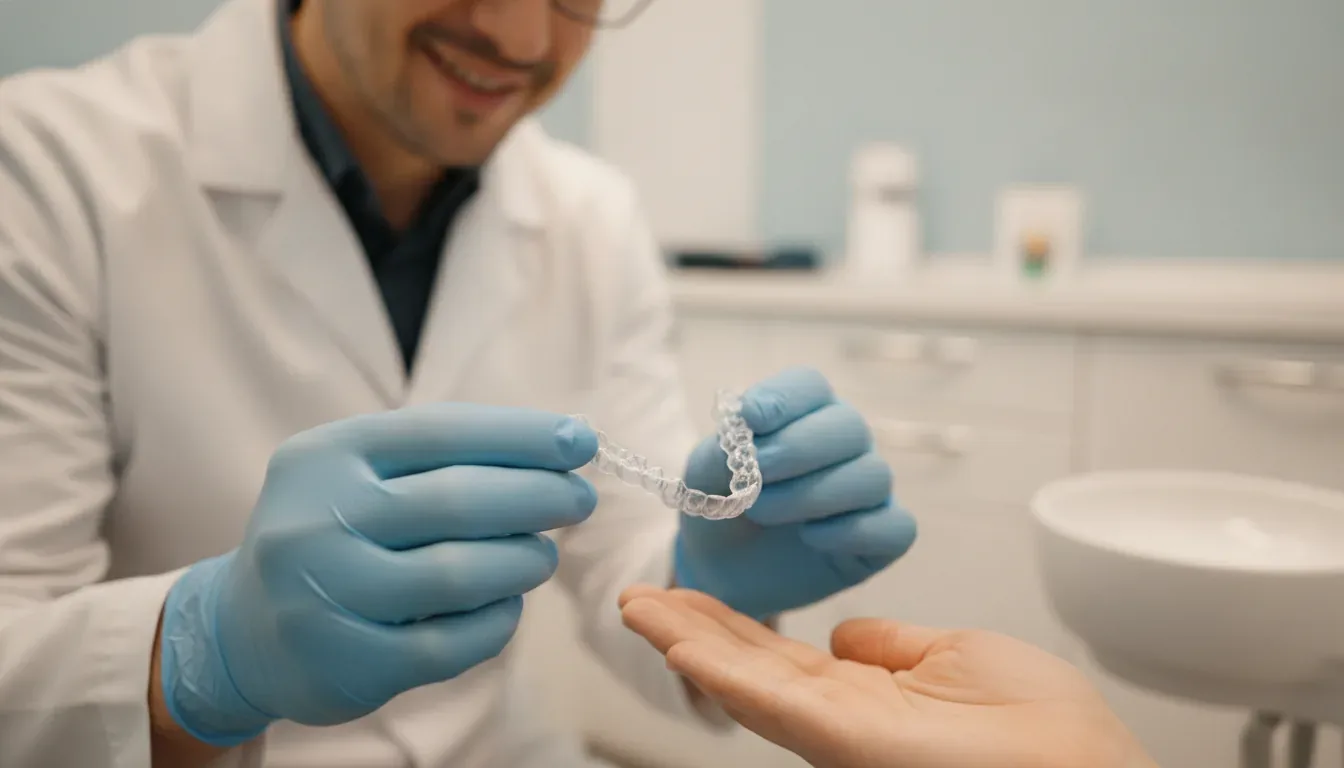
Invisalign is a series of custom clear aligners you change on a set schedule, and how long the whole plan runs depends on how far your teeth have to move. If someone has already quoted you a number, you are probably wondering whether that number will hold.
Align Technology, the company behind Invisalign, does not publish a fixed length. Its own answer is that treatment time depends on the product, your wear time and how complex your case is, and that your doctor determines it. That makes how long does Invisalign take a question with two parts. One is the usual published range. The other is what pushes a plan past it.
How long does Invisalign take
Most Invisalign plans, going by published treatment timelines, run about 6 to 18 months, and 12 to 18 months is the figure quoted most often for adults. Your own length will be set by the doctor who plans your case, working from how far your teeth have to move.
Those ranges come from other dental practices, not from us. The American Association of Orthodontists is more careful than any of them, and says the number of aligners and the treatment time vary with the individual’s orthodontic issues. Align Technology says the same and leaves the number to your doctor. So no single average answers how long does Invisalign take for you. Valley View Dental has not published a range from its own completed cases.
Case complexity is what moves that number most.
What this guide covers
How long does Invisalign take for mild, moderate and complex cases
Mild crowding or spacing sits at the short end of published plans, at about 6 to 9 months. Moderate cases, the ones with more rotation or a bite to correct, are commonly published at about 9 to 15 months. Complex cases run about 15 to 24 months or longer.
What separates the bands is how far the teeth have to travel, and Align Technology puts a measurement on it. Its definition of mild to moderate malocclusion is crowding and spacing up to 6mm, with overjet and overbite up to 6mm, assuming each aligner is worn a week. Past those figures, you are into the longer bands.
That is why crowded teeth and small gaps often finish sooner than a case with an overbite to close. It also explains how two people quoted the same range can take very different amounts of time.
Valley View Dental has not published which Invisalign product tiers it offers.
The stages inside that number are where the time goes.
What does the Invisalign timeline look like, month by month
Your Invisalign timeline is a set sequence of scan, aligners, check-ins and retainer, and each stage has its own window. Only the middle one is long.
1. Scan and plan. About 2 to 4 weeks from your scan to the day your first aligners arrive. Your orthodontist maps every movement before the first tray is made.
2. The aligner series. Each set of trays is worn about one to two weeks before you switch to the next, according to the American Association of Orthodontists. This stage carries almost all of the months.
3. Check-in visits. Published practice timelines commonly put these about every 6 to 8 weeks.
4. Retainer. The last aligner comes out and a retainer goes in. Valley View Dental lists Retainers as one of its orthodontic services.
Read month by month, the shape is plain. The front and back ends are short. The long stretch is the tray sequence in between, which is why the first visible change matters so much for staying with it.
When will you start to see your teeth move
Most people see the first visible change within about 4 to 6 weeks, and a clearly noticeable difference by about 2 to 3 months. Some report movement as early as two weeks, though that is the fast end rather than the norm.
Most of that early movement shows in the front teeth, so you tend to see results there first. That is also why people start to notice their own progress before anyone else comments on it.
When you see results is a different question from how long the full plan will take. Early movement does not mean Invisalign is nearly finished. It means the aligners are doing their work, and that work depends almost entirely on wear time.
Do you really have to wear Invisalign 22 hours a day
The American Association of Orthodontists publishes wear guidance of at least 22 hours a day, with each aligner worn about a week. In its clear aligner guidance it states the same rule as 20 to 22 hours a day, or as prescribed by your orthodontist.
Yes, that is the real target. Invisalign works on steady pressure, so the hours are not a suggestion. They leave you roughly two hours for meals, drinks other than water, and brushing, which is the whole reason the trays come out at all.
Valley View Dental publishes the same figure on its teen orthodontics page. Aligners there need to be worn 20 to 22 hours a day to work.
That matters because wear time is the one part of how long your plan runs that sits with you. Fall short of it and the plan starts to slip.
What makes Invisalign take longer
Wear time is the one factor you control, and it is the most common reason a plan runs past its estimate. The American Association of Orthodontists is direct about this. Inconsistent aligner wear can hold back progress, and it either extends treatment or compromises the result.
Here is what makes Invisalign take longer, and how much of each one is in your hands:
- Hours out of the mouth. Every hour under the target adds up, and missing enough of them puts you behind the plan your orthodontist mapped.
- Case complexity, which the American Association of Orthodontists ties to your own orthodontic issues. No amount of discipline changes how far a tooth has to travel.
- An extra set of aligners at the end, called refinement trays. Patients frequently report treatment running past what they were first told.
- Attachments and elastics added mid-plan.
- A lost, cracked or non-seating aligner.
A delay is not a reason to panic. It is a reason to ask, at your next check-in, how long your remaining trays will take at the wear time you are managing in real life.
The item on that list most people meet first is refinement trays.
What are refinement trays, and do they add time
Refinement trays are a second, usually shorter set of aligners ordered after your first series ends, and they finish the last small movements. They add time to the original plan.
They are not a sign that something went wrong. Teeth do not always land exactly where the plan predicted, so your orthodontist takes a new scan and orders a short refinement series to close the difference. For many people that is a normal part of Invisalign.
What is fair to say is that refinements are the most common reason the number you were quoted at the start turns out to be wrong. A refinement series makes the whole plan longer than the first estimate. Patients report this often in public forums, comparing what they were told it would take against what it did.
Valley View Dental has not published how often refinement trays are needed for its own cases.
Refinements are also part of why Invisalign gets compared with braces on time.
Does Invisalign take longer than braces
Clear aligner treatment, compared with fixed braces on time alone, can be faster, depending on how complex the case is. That is the American Association of Orthodontists’ position, and practice pages commonly put it more simply, saying Invisalign is usually faster than traditional metal braces. Neither line tells you how long yours will take, or whether braces would take longer.
The comparison that decides it is not a general one. In orthodontics, an orthodontist is the right professional to work out whether braces or clear aligners suit your case, and Valley View Dental offers both. Either route ends with the same next job: keeping the result.
How do you keep your results after the last aligner
A retainer is what holds teeth in their new position, and you wear one after the last aligner so they do not drift back. Keeping your results is the closing stage of the plan, not a separate project.
Valley View Dental lists Retainers as one of its three named orthodontic services, alongside Traditional Braces and Invisalign and Clear Aligners. The handover from your last set of aligners to your first retainer happens in the same practice.
How long you wear it, and how often, is set for your case by your dentist or orthodontist, not read off a page. Valley View Dental has not published its own schedule.
That is the calm version of what happens at the end. It helps to know the other version too, which is what to do when something is not going to plan.
When should you call your dentist during Invisalign
Call your dentist for the situations that need a look rather than a wait: an aligner that will not seat, a lost or cracked tray, an attachment that comes off, or discomfort that does not settle.
Call about:
- An aligner that will not seat properly, even after chewing it in
- Aligners that are lost, cracked or damaged at any point during your Invisalign series
- Attachments that come loose or fall off
- Pressure or soreness that lasts beyond the usual 24 to 48 hours after switching to a new tray
- Any stretch where you know you have fallen behind on wear time
The last item on that list matters as much as the rest. Falling behind is easier to fix early, and how long the fix takes depends on how soon you say something.
Valley View Dental takes calls on one central number, (630) 509-7933, for Romeoville, Naperville and Montgomery. Same-day emergency care is available. Your orthodontist can usually tell you in a minute whether to keep going or come in.
Those are the calls worth making. Below are the questions people ask most.
Invisalign timeline questions people ask most
What is the 30 minute rule with Invisalign?
The 30 minute rule is a commonly used rule of thumb for keeping your trays out of your mouth as briefly as possible at each meal. It is not a published clinical standard. The sourced rule is the American Association of Orthodontists’ wear guidance of at least 22 hours a day, and your own dentist sets the detail for your case.
Do people really wear Invisalign 22 hours a day?
Yes, that is the published standard. The American Association of Orthodontists gives at least 22 hours a day, and states it elsewhere as 20 to 22 hours a day or as prescribed by your orthodontist. The hours left over cover eating, drinking anything other than water, and cleaning your teeth.
What is the hardest week of Invisalign?
No source names a hardest week. What is documented is an adjustment window of about 24 to 48 hours each time you switch to a new tray, and that window repeats through the series.
Is Invisalign painful to wear?
Most people describe pressure and tightness rather than pain, usually for a day or two after switching trays. That feeling is the aligners doing their work. Tell your dental team if it does not settle, and they will check the fit.
Why do dentists not recommend Invisalign?
Clear aligners suit many cases and not every case. The American Association of Orthodontists takes the view that an orthodontist is the right professional to work out whether braces or clear aligners suit a particular case. That is a case-by-case call, not a general position for or against Invisalign.
Do you wear a retainer forever after Invisalign?
Retainer wear continues after your last aligner to hold the result, and the schedule is set for your case by your dentist or orthodontist. There is no single schedule that fits everyone.
long does Invisalign take for adults?
Published timelines put most adult Invisalign plans at 12 to 18 months. That is the figure quoted most often across practice pages and in Google’s own summary for this question, and your own number still comes from your scan.
How long does Invisalign take to fix an overbite?
No published source gives a month figure for an overbite on its own. Align Technology’s definition of mild to moderate malocclusion includes an overbite of up to 6mm, which puts many overbite cases inside the shorter published bands. A scan is the only way to get a number for yours.
How long does Invisalign take for gaps?
No published source gives a month figure for gaps on their own. Spacing of up to 6mm sits inside Align Technology’s mild to moderate definition, and mild cases are commonly published at about 6 to 9 months. Your own case still needs a scan.