The dental chair is where the waiting, the sounds and the feeling of not being in control hit hardest. You can move your attention somewhere else on purpose, and it helps. As NHS inform puts it, a distraction takes the focus away from the noises that make you anxious.
If dental anxiety builds before every appointment, this guide shows how to distract yourself at the dentist, step by step. Start with the short version.
What is the fastest way to distract yourself at the dentist
The fastest way to distract yourself at the dentist is to keep your ears and hands busy. Agree on a stop signal before the dentist starts. You can use these five steps before and during your visit.
- Tell the office you’re nervous when you book, and again when you arrive.
- Agree on a signal, like raising your hand, for when you need a break.
- Wear headphones and play your favorite music or an audiobook.
- Squeeze a stress ball, or hold a small object like a fidget spinner.
- Count your breaths: breathe in slowly, then out for the same count.
Knowing why distraction works makes these steps easier to use.
What this guide covers
Why does distraction help when you’re nervous at the dentist
Dental fear is common in US adults: 72.6% said they were afraid of going to the dentist. That figure comes from a September 2025 national survey in the Journal of the American Dental Association (JADA). If you feel nervous, you’re far from alone.
The researchers surveyed 1,003 US adults, a sample chosen to match the country’s makeup. Of everyone surveyed, 45.8% called their fear moderate and 26.8% called it severe.
Dental anxiety has roots you can name. Human biology, bad past experiences and negative dental stereotypes.
Distraction helps because it gives your attention a job. NHS inform explains that it pulls your focus off the noises that make you anxious.
The in-chair steps work better when you prepare before your appointment.
What should you do before your appointment
Before your appointment, the most useful step is telling the office you’re nervous. Do it twice: when you book and when you arrive.
Step 1: Tell the office you’re nervous
How to do it: The American Dental Association (ADA) puts speaking up first. When you book, tell the receptionist you’re nervous about dental visits. When you arrive, remind the dentist and dental staff. Share any bad experiences from past visits, and ask for ideas to help you cope. Don’t be afraid to ask questions. Cleveland Clinic also suggests booking a quieter time of day.
Common mistake: Telling no one because it feels dramatic. This is the step people skip.
Step 2: Load your headphones with something you know
How to do it: Pack headphones and pick music, a podcast or an audiobook you already know well.
Common mistake: Loading a new playlist. Unfamiliar audio takes attention to follow, so choose something familiar.
Step 3: Bring a calm friend
How to do it: Some people find it helps to bring a friend or family member along.
Common mistake: Bringing someone who is nervous too. Pick a person who stays calm.
There is one more thing to agree on before the dentist starts: a stop signal.
How do you agree on a stop signal with your dentist
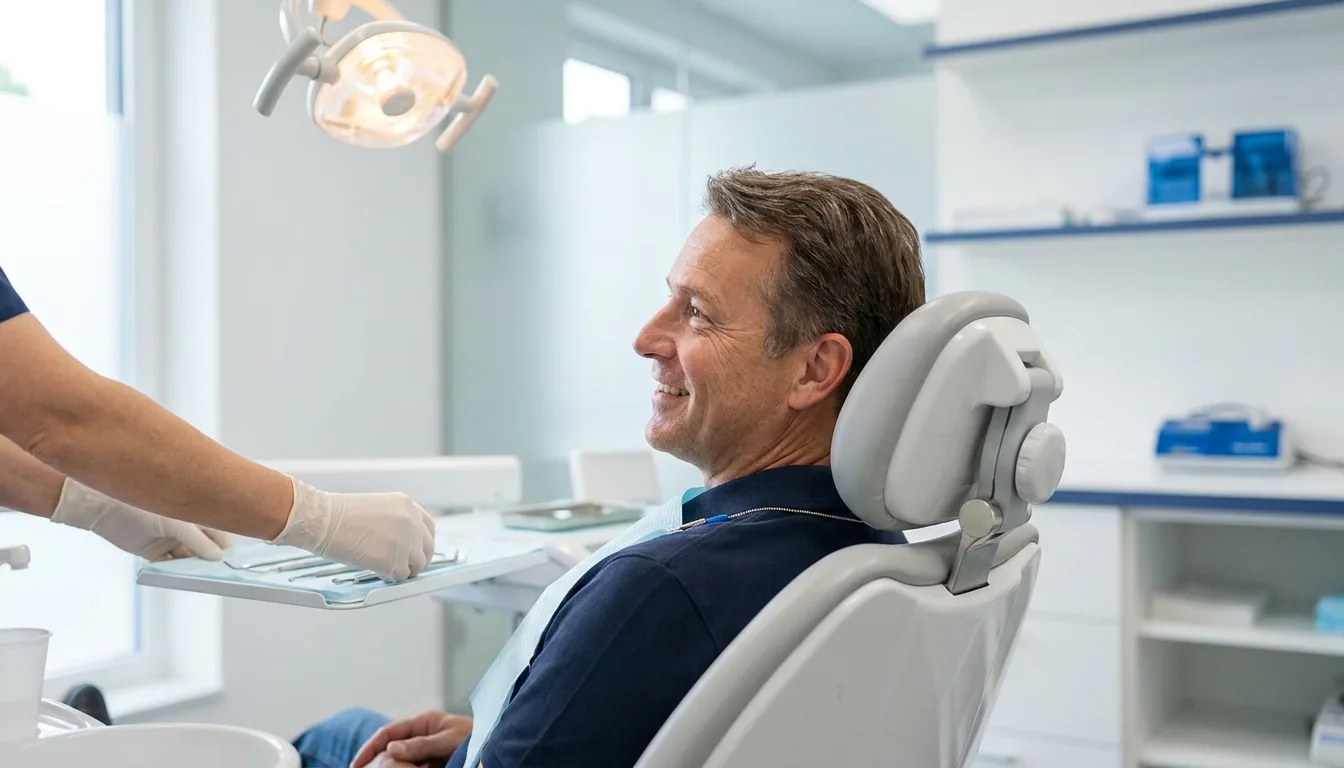
A stop signal is a gesture agreed before treatment, usually a raised hand, that lets you pause without speaking. Ask your dentist to agree on one before any work begins.
The American Dental Association (ADA) advises you to agree on a signal. Its wording is plain:
“Let your dentist know by raising your hand if you need to take a break during an exam.”
NHS inform gives the same advice. Use the signal if you feel overwhelmed or want the treatment to stop for any reason.
Set it up while you can still talk. Agree that you’ll raise your hand, or pick another gesture that feels natural.
Common mistake: Agreeing on a signal, then not using it. A short break is normal, and asking for one is fine.
Once the signal is set, give your ears and hands something to do.
What can you use to distract yourself in the dental chair
The distractions that help most in the dental chair each give one sense a job. Pick one for your ears, your hands, your eyes or your thoughts. Bring your own items from home, and choose one or two to distract yourself with.
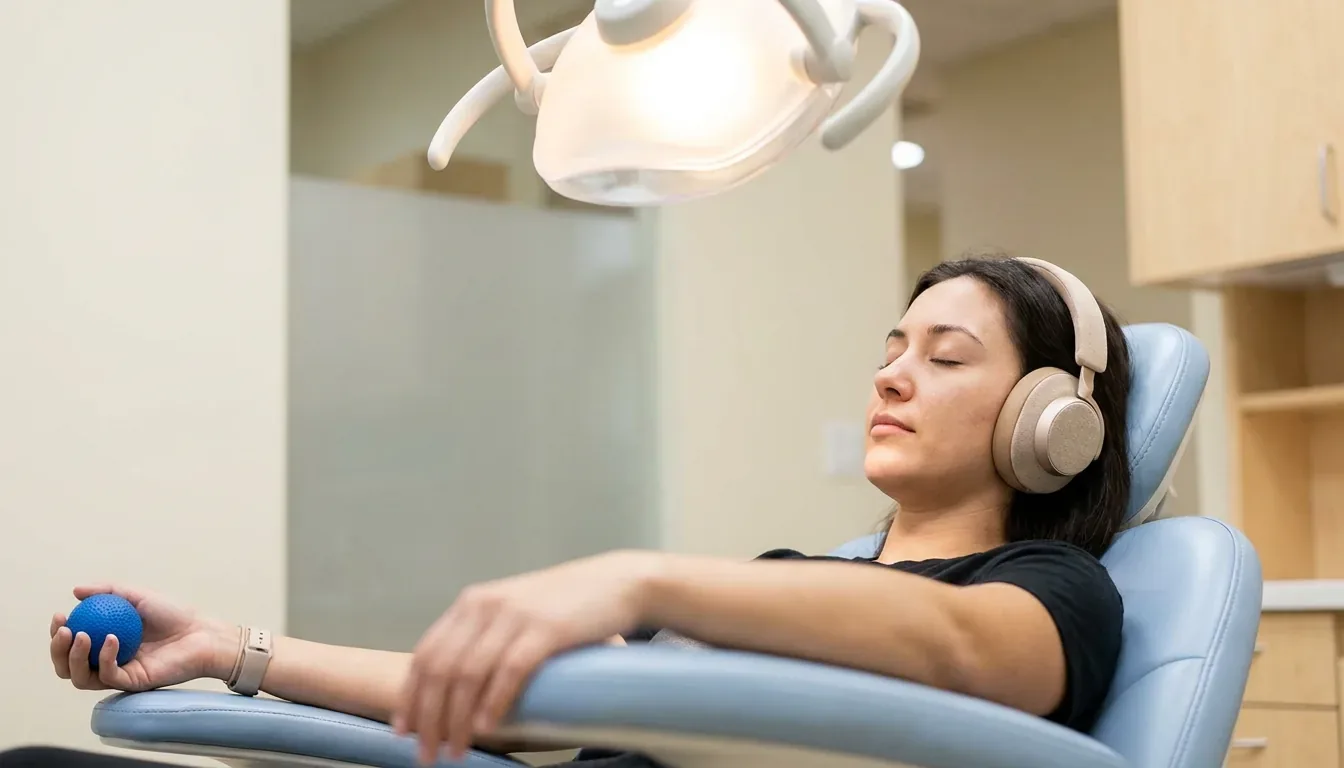
- For your ears, wear headphones. If the sound of the drill bothers you, the American Dental Association (ADA) suggests your favorite music or an audiobook. A podcast works too.
- Keep your hands busy. Harvard Health suggests a stress ball you can squeeze to release tension during the procedure. The ADA names a small handheld object, like a fidget spinner. Penn Dental Medicine lists comfort items, such as squeezable balls or small stuffed animals.
- Let your eyes rest. Some people describe closing their eyes against the bright light, with a small fidget toy in hand.
- Give your mind a task. The ADA suggests picturing your happy place, like a relaxing beach or garden. Some people do puzzles in their head, or plan tasks for later in the day.
These tools move your attention away from the work. They don’t numb anything.
Two common mistakes:
- Playing audio so loud you can’t hear your dentist. Then treatment has to stop anyway. Aim for loud enough to blur the drill.
- Holding something you need to look at. Whatever you hold should work with your eyes closed.
If a distraction slips mid-appointment, your breathing is the backup.
How do you use breathing to calm down mid-appointment
Counted breathing, where you inhale slowly and exhale for the same count, gives your mind a job when distraction slips. You can do it in the waiting room or during a break in the chair.
- Breathe in slowly and count as you go.
- Breathe out for the same number of counts.
- Repeat five times.
The American Dental Association (ADA) suggests five rounds while you wait, or during breaks in the dental chair. Harvard Health explains why it helps. Tien Jiang, DMD, MEd, says focused breathing can slow your heart rate and put you at ease.
If your muscles stay tense, try a body scan. Relax your muscles one body part at a time, the ADA says. Start with your head and work your way down to your toes.
Common mistake: Breathing fast and shallow while trying to breathe deeply. Slow and counted is the point.

For some people, the worry that keeps them away is being judged.
What if you feel embarrassed or worried about being judged
Feeling embarrassed about your teeth is a common reason people put off the dentist, sometimes for years. Saying it at the start changes how the visit is run.
If you’re scared to go because of bad teeth, or worried about being judged, say so. The American Dental Association (ADA) suggests sharing any bad experiences you’ve had, and asking for ideas to help you cope.
Valley View Dental’s approach to comfort is gentle and judgment-free. The practice has provided family dental care in Romeoville, Naperville and Montgomery for more than two decades.
Sometimes the nervous one in the room is your child.
How do you help a nervous child at the dentist
A nervous child needs the same tools, scaled down. That means something to hold, something familiar to listen to, and a signal they pick themselves.
Penn Dental Medicine suggests comfort items, such as small stuffed animals. A favorite toy from home is another option. A song or story your child knows well can play through headphones.
Let your child choose their own signal. Then agree on it with the dentist before treatment starts.
Common mistake: Making promises about how it will feel. That sets up the one thing you can’t control. Describe what will happen instead.
Whoever is in the chair, you’ll want a way to tell it’s working.
How do you know it’s working
It’s working when you can manage the fear through the visit, not when the fear disappears. Fear isn’t on or off. The 2025 JADA survey found it on a range, from moderate to severe.
Signs of progress to notice:
- You finish an appointment.
- You try a new relaxation technique.
- You feel less anxious than at earlier visits.
Plan a small reward for after the visit. It helps you connect dental visits with something good. Note what helped, so you can use it again next time.
If the fear still keeps you from booking, technique may not be enough on its own.
When is distraction not enough
Distraction is a coping tool, not a treatment for severe dental fear. If it isn’t getting you through the door, the next step is help aimed at the fear itself.
Severe fear is not rare. In the 2025 Journal of the American Dental Association survey, 26.8% of US adults called their fear severe.
Many people want that kind of help. Of adults with dental fear, 71.2% said they would be interested in free online treatment lasting one to three hours.
Cleveland Clinic calls exposure therapy one of the main treatments for a fear of dentists. It means getting used to the dentist gradually. One step can be visiting a dental office without treatment.
Cognitive behavioral therapy (CBT) aims to change both negative thoughts and actions, Harvard Health explains. Many healthcare providers use CBT along with exposure therapy, according to Cleveland Clinic.
If distraction is not enough, try these steps:
- If you’re scared of the dentist, talk to your dentist and say so plainly.
- Ask for breaks, or for shorter visits.
- Ask whether you can book a visit just to talk first.
- Use the stop signal you agreed on.
- If your fear is severe, exposure therapy or CBT is an option.
- If you feel pain even with a local anesthetic, tell your dentist.
Below are the questions people ask next.
Common questions about staying calm at the dentist
How do I get over my fear of going to the dentist?
The American Dental Association names three ways to stop fearing the dentist: speak up, distract yourself and use mindfulness techniques. For severe fear, exposure therapy and cognitive behavioral therapy (CBT) are treatments aimed at the fear itself.
How do you go to the dentist when you’re scared?
Tell the office when you book and again when you arrive. Say plainly that you’re scared. Agree on a stop signal with your dentist, and bring headphones with something familiar to play.
How do you relax your tongue at the dentist?
To relax your tongue, try the American Dental Association’s body scan, and start with your head. Relax your face and jaw first, then your tongue, and keep your breaths slow and counted. Ask your dentist what position helps, and use your signal if you need a break.
What if I’m scared of the dentist but need treatment?
Say so before treatment is planned, so your dentist knows from the start. Ask for breaks or shorter visits if that helps. It’s also fine to ask whether you can book a visit just to talk first. If the fear is severe, exposure therapy or CBT is an option aimed at the fear itself.