You had a root canal, the tooth settled down, and now it hurts again. A root canal (endodontic therapy) clears infection out of a tooth and seals the canals, but it does not shut that tooth off from bacteria forever. So yes, a treated tooth can get an infection again. What follows covers the signs that matter, how to tell trouble from ordinary healing, what a dentist does about it, and when the tooth needs looking at the same day.
The short answer
A root-canalled tooth can develop an infection again, sometimes years later, when bacteria get back into the sealed root canal through a cracked or loose crown or filling, new decay, or a canal that was missed the first time. Swelling in your face or jaw, or a fever with the tooth pain, means see a dentist the same day.
Table of Contents
Why can a tooth that already had a root canal get infected again
A root canal (endodontic therapy) removes the infected pulp from inside a tooth, then cleans, fills and seals the canals. Once a tooth is sealed, that seal holds for most teeth. It can still be broken, and once it is broken, bacteria have a way back in.
The American Association of Endodontists names four routes:
- Narrow or curved canals were not treated during the first procedure, or complicated canal anatomy went undetected.
- The crown or other restoration was placed later than it should have been after treatment.
- The crown or filling did not keep saliva out of the inside of the tooth.
- New decay, a loose, cracked or broken crown, or a fracture in the tooth.
Most of those routes are mechanical rather than a matter of how the first treatment was done. A second infection is usually not a sign that someone worked badly. What it looks like from the outside is a set of signs you can check yourself.
What does a reinfected root canal feel like
A reinfected root canal usually shows up as pain when biting, swollen or tender gums near the tooth, and a small pimple or boil on the gum. A single sign on its own can have other causes. Several of them together point more clearly at infection.
Cleveland Clinic and the American Association of Endodontists list these signs around a treated tooth:
- Severe or throbbing pain when biting down.
- Swollen or tender gums near the tooth.
- A small pimple or boil on the gum line.
- Prolonged sensitivity to hot or cold.
- A bad taste or foul smell in your mouth.
- The treated tooth turning darker than the teeth beside it.
The crown on top can look fine while the trouble sits underneath it, so how the tooth looks is not the test. Some of these signs also show up while a tooth is settling down after treatment, which is the harder thing to sort out.
How do you tell normal healing from a real reinfection
Normal healing after a root canal has one direction of travel: getting better, week by week, and easing over the weeks that follow. A reinfection travels the other way. It is getting worse instead of fading, or the pain came back months or years later after the tooth had already settled.
Swelling is the exception to that test. Swelling and a pimple on the gum point at infection at any point after treatment, whether the tooth was treated recently or a long time ago.
Two patterns to check against your own tooth:
- Pressure or pain on biting that came back after the tooth had settled.
- Pain that keeps building rather than easing.
A crown that has come loose, or that feels different when you bite on it, belongs on the list you take to the appointment.
The gap between the treatment and the trouble can be very long, which raises its own question.
Can a root canal get infected years later
A root-canalled tooth can get an infection years later, and a long gap usually points at something new rather than at the original work. New decay, a loose, cracked or broken crown or filling, or a fracture in the tooth are the usual late causes, according to the American Association of Endodontists.
One long-term study followed 598 treated teeth for 5 to 37 years. It found 97 percent of those teeth still in place at 10 years, 81 percent at 20 years, 76 percent at 30 years and 68 percent at 37 years. The study, by Lopez-Valverde and colleagues, was published in Clinical Oral Investigations in 2023.
A tooth that carried a root canal for fifteen years and then went wrong is not evidence of a bad first treatment. Teeth keep taking load, crowns wear, and decay finds new edges. How often treatment holds has been counted, and that figure is a fair thing to ask for.
How often does a root canal fail
Root canal treatment was counted as a success in 93 percent of teeth at 10 years and 85 percent at 20 years in one long-term study, with 81 percent counted as successes at both 30 and 37 years. That study followed 598 treated teeth in 312 patients for 5 to 37 years, an average of 21 years, and appeared in Clinical Oral Investigations in 2023.
Those figures are for a first root canal, and they come from one group of patients rather than from every practice.
How often a root canal fails is the other side of the same figures. Where a root canal does fail, the usual outcome is more treatment rather than a lost tooth, and what that treatment involves is the next question.
What will a dentist do to diagnose and fix it
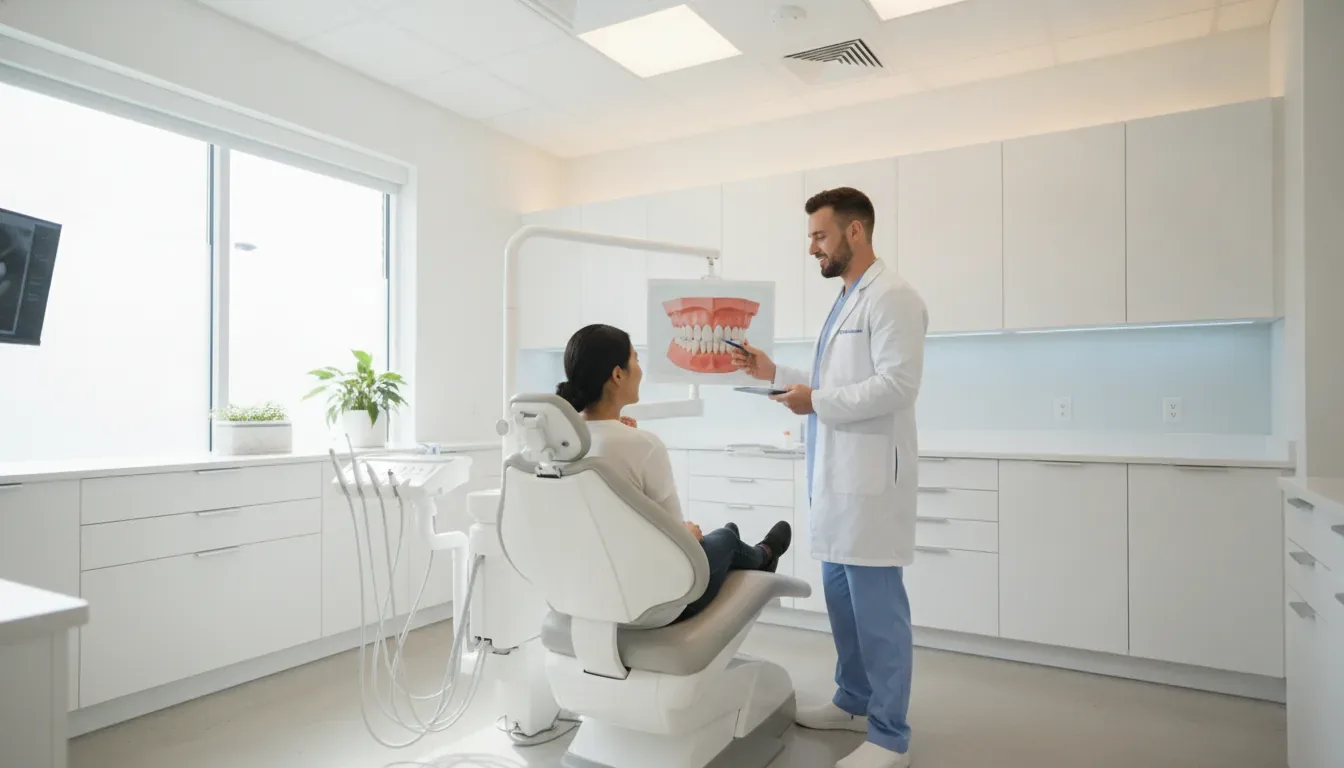
A dentist starts with an X-ray of the root and the bone around it, then examines the tooth and the crown or filling sitting on it. That is how they diagnose the problem before anyone proposes treatment. Three treatments follow from what the X-ray shows: root canal retreatment, an apicoectomy, or tooth extraction.
Root canal retreatment reopens the tooth. The endodontist removes the filling material placed in the canals during the first procedure, cleans and shapes those canals again, then refills and seals them. The tooth is restored afterwards.
An apicoectomy is minor surgery that clears the infection from the tip of the root.
Tooth extraction removes the tooth, and it is the option when the damage is past saving.
Retreatment is endodontic work and extraction is the oral surgeon’s, so the two options sit with different specialists. At Valley View Dental, an endodontist, Dr. Fuwad Al-Sabek, and a board-certified oral and maxillofacial surgeon, Dr. Anthony Lotesto, both work in the practice. Valley View Dental has been treating patients for over two decades, so both options can be looked at in one place.
Many people hope for a shorter route than any of this, and it usually goes by the name of antibiotics.
Will antibiotics fix an infected root canal
Antibiotics act on the infection in the tissue around the tooth. They do not reach the source of it, which sits sealed inside the root canal, so the infection can come back once the course ends.
Penn Dental Medicine sets out the order as draining the abscess, prescribing antibiotics, then root canal treatment or extraction. Antibiotics sit alongside a procedure in that order, never in place of one.
Feeling better on a prescription is not the same as the tooth being treated. Easing pain tells you the medicine is working on the tissue around the tooth. It does not tell you the source inside the tooth has gone. Removing that source means root canal retreatment, surgery at the root tip, or tooth extraction.
If you are already taking a prescription, keep any questions about it for the dentist or doctor who wrote it, and book the dental appointment as well. There is also a point where waiting for an appointment stops being reasonable at all.
When does this become an emergency
Swelling that spreads means the infection has moved beyond the tooth, and that needs same-day care. Swelling in your face or jaw, swelling that is getting larger, or a fever alongside the tooth pain are the signs that turn this from an appointment into an emergency. Call a dentist that day rather than waiting for a routine slot.
Valley View Dental offers same-day emergency care in Romeoville, Naperville and Montgomery, Illinois, and the surrounding areas. The number is (630) 509-7933.
Same-day care deals with the spreading infection first. Whether the tooth then needs retreatment or tooth extraction is decided after that. Some people arrive at this question carrying a bigger one, about whether root canals cause health problems at all.
Do root canals cause other health problems
The American Association of Endodontists states that there is no credible scientific evidence that root canal treatment causes cancer, heart disease, arthritis, autoimmune disorders, or other systemic diseases.
The belief traces back to the focal infection theory of the early 1900s, which suggested that bacteria trapped in teeth could spread and cause illness elsewhere in the body. That theory rested on research done before modern sterilization, imaging and microbiology existed. Contemporary peer-reviewed research has discredited those claims, according to the same association.
The health problems question and the reinfection question are separate ones. A treated tooth that gets infected again is a local problem in one tooth, and it is treated locally. What is left is the handful of questions people ask most often.
Common questions about an infected root-canalled tooth
What happens if my root canal tooth gets infected?
The infection spreads from inside the tooth into the bone around the root tip, which the American Association of Endodontists describes as an abscess. It needs treatment rather than time.
How long can a root canal stay infected?
An infection inside a treated tooth does not clear up on its own. It stays until the source inside the tooth is treated, so there is no waiting period that fixes it.
Can an infected tooth be saved with a root canal?
Often yes. For a tooth that already had a root canal, the equivalent is root canal retreatment, which reopens the tooth and cleans the canals again.
What are the signs that a tooth infection is spreading?
Swelling in your face or jaw, and a fever alongside the tooth pain. Those two signs mean the same day, not next week.