An implant, a bridge or denture all replace missing teeth, each in a different way. The right one depends on your bone, your budget, and how many teeth are missing, not on what earns a practice the most.
Here is the honest short version. A dental implant is usually the better call for a single missing tooth when your jaw is healthy. A dental bridge fits well when the neighboring teeth already need crowns, or when bone is thin. A denture, full or partial, fits when several or all teeth are missing, or when cost decides.
You do not have to take one opinion on faith. Valley View Dental is doctor-owned. It offers a free second opinion on any treatment plan, so you can check any recommendation before you commit. Here is the one-glance version.
Table of Contents
The quick answer at a glance
In short, a dental implant is the better choice for a single missing tooth when your jawbone is healthy and you want a stand-alone tooth. A dental bridge is the better choice when the neighboring teeth already need crowns, or when there is not enough bone for an implant. A denture or partial denture is the better choice when several or all teeth are missing, or when cost is the deciding factor.
The main difference is how each one anchors. Implants stand on their own. Bridges lean on the teeth beside the gap. Dentures rest on the gum and lift out. First, what actually makes them different.
What is the difference between an implant, a bridge and a denture
A dental implant is a titanium post placed in the jawbone, topped by a crown. It replaces one missing tooth, both the root and the visible tooth. Because it sits in the bone, an implant also stimulates and helps preserve the jawbone.
A dental bridge is a false tooth held in place by crowns on the two neighboring teeth. It fills a gap without surgery. The neighboring teeth carry the load.
A denture is a removable appliance that holds false teeth. A partial denture replaces one row or a few teeth. A full denture replaces a whole arch. Both are removable. Dentures lift out for cleaning.
The difference between the three comes down to how they attach and how many teeth they replace. Side by side, the trade-offs get clearer.
Implant vs bridge vs denture – a side-by-side comparison
Here is how the three compare on the axes that matter: cost, treatment time, durability, bone health, and who each one suits. Reading implant versus bridge versus denture side by side makes the choice clearer than any single number. No option is simply better than another. Each wins in different cases.
| Factor | Dental implant | Dental bridge | Denture or partial |
| Durability | About 95% 10-year survival for single implants (Moraschini 2015 / Howe 2019; clinician to confirm) | About 89% 10-year survival for tooth-supported bridges (Pjetursson, Clinical Oral Implants Research; clinician to confirm) | Removable; usually relined or remade over the years as the ridge changes (clinician to confirm) |
| Treatment time | Several months, because the post must fuse to the bone | Usually 2 to 3 weeks, a few visits, no surgery | A few weeks of fittings; fastest to a full set of teeth |
| Cost at Valley View Dental | no cash price. Single-tooth financing from $99/mo* with the Cherry disclaimer; full cases are a custom quote at a free consult] | custom quote at a free consult; no cash price published] | custom quote at a free consult; no cash price published] |
| Bone health | Helps preserve the jawbone; does not rely on neighboring teeth | Requires shaping the two neighboring teeth; does not stop bone loss under the gap | Sits on the gum; does not stop bone loss under it |
| Who it suits | One missing tooth, healthy bone, sound neighbors | A gap between two teeth that already need crowns, or thin bone | Many or all teeth missing, or a budget-led choice |
*From $99/mo reflects financing through Cherry, subject to credit approval. It is not the total cost.
Numbers aside, each one wins in specific situations.
When is a dental implant the better call
A dental implant is a stand-alone replacement, so it does not lean on any other tooth. It is usually the better call for one missing tooth when your jawbone is healthy and the neighboring teeth are sound. You keep those neighboring teeth untouched.
That is the main advantage of an implant over a bridge, and an implant often lasts longer than a bridge (see the survival figures above). A bridge needs the two teeth beside the gap shaped down for crowns. An implant does not touch them.
Implants are not for every case. An implant needs enough healthy bone and time to heal. If the bone is thin, you may need a graft first. At Valley View Dental, an in-house oral surgeon, Dr. Anthony Lotesto, places implants. But a bridge sometimes wins.
When is a dental bridge the better call
A dental bridge is a fixed replacement that needs no surgery. It is often the better call when the neighboring teeth already need crowns, when there is not enough bone for an implant, or when you want a fixed tooth faster.
There is an honest trade-off. To hold the bridge, the two teeth beside the gap are shaped down and capped with crowns. Healthy teeth get reshaped to carry the load. Tooth-supported bridges last about 89% at 10 years.
Bridges are practical when speed matters. At Valley View Dental, CEREC same-day crowns and bridges are made in-house. For bigger gaps, a denture may be the better fit.
When is a denture (or partial) the better call
A denture is removable and replaces many teeth at once. It is often the better call when several or all teeth are missing, or when cost is the deciding factor and you want teeth sooner. A partial denture fills in around the teeth you still have.
There is a middle option worth knowing. A few implants can hold a denture in place for more stability. That is the difference between plain dentures and implant dentures. Implant dentures snap onto implants and move less while you eat.
Dentures need simple care. You take them out to clean them. Over time they are relined or remade as the ridge changes shape. Each option also carries its own risks and recovery.
What are the risks and recovery of each option
Every tooth-replacement option has trade-offs and a recovery. An implant needs healing time to fuse to the bone. A bridge means working on the neighboring teeth. A denture takes some adjustment to wear.
An implant is placed with surgery, then heals over several months as the post fuses to the bone. Any soreness is managed with routine care, and the visit is handled gently and without judgment. About 5% of implants do not fully integrate over 10 years. That is the flip side of a roughly 95% survival rate.
A bridge has its own risk. The shaped teeth under the crowns need care for life, and decay can form under the bridge if cleaning slips. Dentures take practice. Eating and speaking feel different at first, and the fit needs periodic relines as the ridge changes. So how does a dentist actually choose for you?
How does a dentist decide which is right for your case
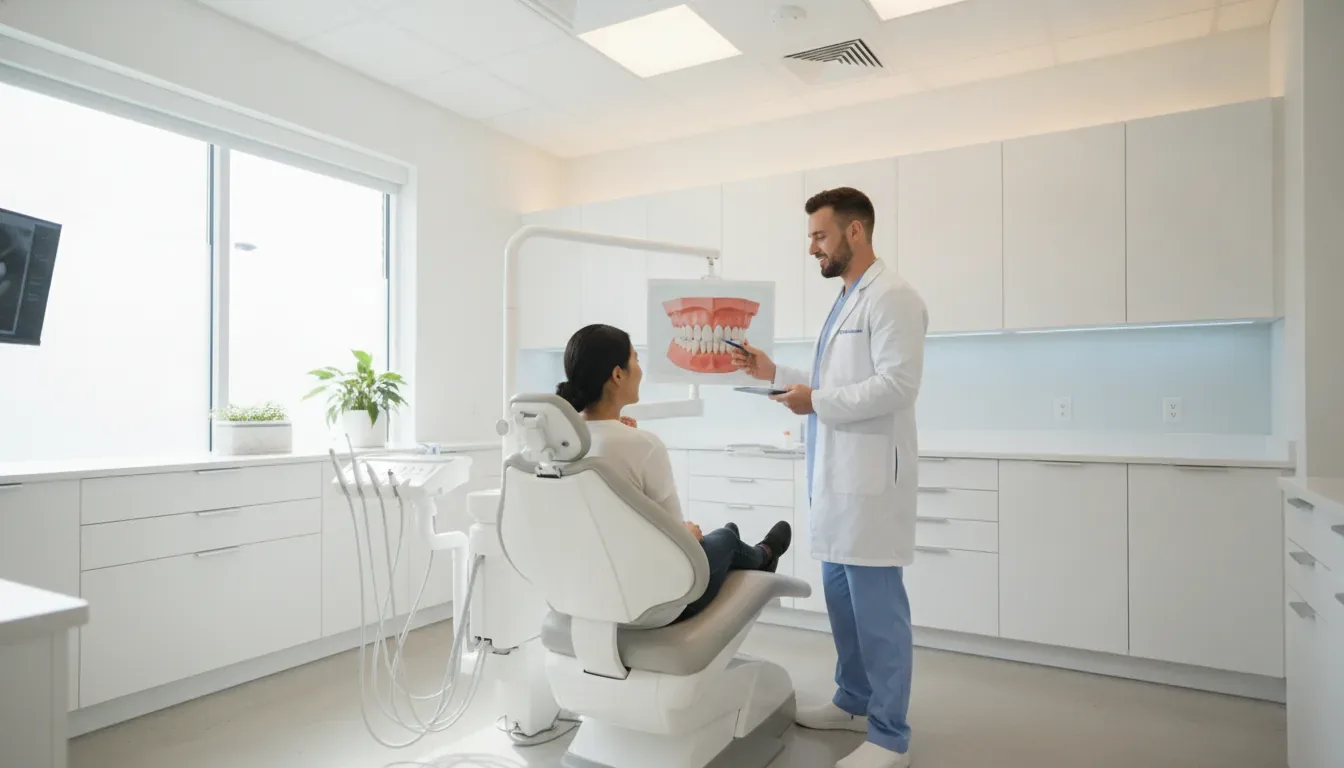
A good dentist starts with your bone, your budget, and your goals, not a sales target. They show you the options and the trade-offs before any treatment begins. You should hear the difference between them, and which is better for your case, in plain words.
That is how Valley View Dental works.The practice is doctor-owned, and it offers a free second opinion on any treatment plan. If a plan feels like too much, you can have it checked at no cost. The choice between an implant, a bridge, and a denture stays yours.
Care also stays under one roof. Valley View Dental has an in-house oral surgeon, Dr. Anthony Lotesto, a prosthodontist, Dr. Tarik Patel, an endodontist, Dr. Fuwad Al-Sabek, and an orthodontist, Dr. Chirag Parikh. You are not referred out. The team has served Romeoville, Naperville, and Montgomery for more than 20 years. Here are the questions patients ask most.
Implant, bridge and denture – common questions
These are the implant, bridge, denture, crown, and root canal questions we hear most.
Are dental implants better than crowns?
A crown and an implant do different jobs, so neither is simply better than the other. A crown covers a damaged tooth you still have. A dental implant replaces a tooth that is already gone. If the tooth can be saved, a crown is right. If it is gone, an implant fills the space.
What is the difference between dental implants and crowns?
The difference between dental implants and crowns is what they attach to. An implant is a new root plus a tooth, set in the jaw. A crown is a cap that fits over an existing tooth, or over an implant.
Root canal vs dental implant – which saves my tooth?
A root canal saves your natural tooth. It cleans the infection inside and keeps the tooth in place. A dental implant replaces the tooth after it is removed. Save the natural tooth when it can still be restored.
Is a dental implant worth the money?
That depends on your case, so the honest answer is to price it at a free consult. Single-tooth implants are financed from $99/mo* through Cherry. Full cases are a custom quote at a free consult. No cash price is set here.
What is the downside of dental implants?
The main downsides are healing time, the need for enough bone, and a small failure rate. About 5% of implants do not integrate over 10 years. Most people heal without trouble, but it is fair to know the risk.
How much will insurance pay for dental implants?
Coverage varies by plan, so we check yours before you decide. Valley View Dental accepts most major PPO plans. We will tell you what your plan covers and what it does not.
Is a denture as good as an implant?
Dentures and implants do different jobs. Dentures replace many teeth affordably and lift out for cleaning. Implants replace teeth one at a time and help preserve bone. One is not better than the other, they fit different needs.
Implant, bridge or denture – the honest verdict
Now you can see how the three compare. A dental implant stands on its own and suits a single missing tooth when your jawbone is healthy and the neighboring teeth are sound. A dental bridge leans on the two teeth beside the gap, so it fits when those teeth already need crowns, or when there is not enough bone for an implant. A denture, full or partial, rests on the gum and lifts out, and it fits when several or all teeth are missing, or when cost decides. No option is simply better than the others. The right one depends on your bone, your budget, and how many teeth are missing.
That is where we come in. Valley View Dental shows you the options and the trade-offs before any treatment begins, and offers a free second opinion on any plan, so a bridge or denture recommendation is one you can check before you commit. With an oral surgeon, prosthodontist, endodontist, and orthodontist under one roof, most cases are handled in-house with no referral. Call (630) 509-7933 or book a free consult to see which option fits your case, with your cost in writing before you decide.